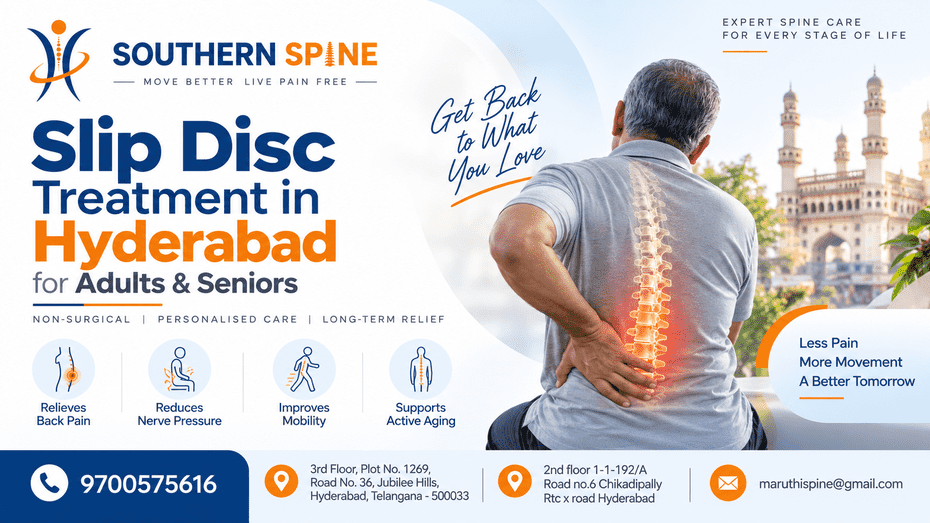
Slip Disc Treatment in Hyderabad for Adults & Seniors
- Home
- Blogs
- Slip Disc Treatment in Hyderabad for Adults & Seniors
Categories
Recent Blogs
Slip Disc Treatment in Hyderabad for Adults & Seniors
If you are looking for slip disc treatment in Hyderabad, you may be experiencing lower back pain, neck pain, stiffness, numbness, tingling, or pain that travels into the legs or arms. A slipped disc, also called a herniated or bulging disc depending on the underlying condition, can affect adults and older individuals and may interfere with walking, working, sleeping, and everyday activities.
The right treatment depends on the location and severity of the disc problem, the symptoms you have, your age, medical history, and whether nerves are being affected.
At Southern Spine, treatment for spine-related conditions can include chiropractic care, physiotherapy, corrective exercises, rehabilitation, manual therapy, and other conservative approaches based on individual assessment.
What Is a Slip Disc?
The spine contains small cushions called intervertebral discs between the vertebrae. These discs help absorb shock and allow the spine to move comfortably.
A disc may become damaged, bulge, or herniate and sometimes irritate nearby nerves. This can result in back or neck pain and, in some cases, symptoms such as tingling, numbness, or weakness.
The term slip disc is commonly used by patients, although healthcare professionals may use terms such as disc bulge, disc herniation, or prolapsed disc, depending on the specific condition.
Common Causes of Slip Disc
A slipped or herniated disc can develop for different reasons. Common contributing factors include:
- Age-related changes in the spinal discs
- Poor posture
- Repetitive bending or twisting
- Incorrect lifting techniques
- Prolonged sitting
- Lack of physical activity
- Sudden injury
- Repetitive strain
- Muscle weakness
- Excess body weight
For older adults, natural age-related changes in the spine can make discs more susceptible to degeneration.
Symptoms of a Slipped Disc
Symptoms depend on the location of the affected disc and whether a nerve is irritated or compressed.
Common symptoms may include:
- Lower back pain
- Neck pain
- Pain extending into the leg or arm
- Numbness or tingling
- Muscle weakness
- Stiffness
- Difficulty with certain movements
- Pain that becomes worse with sitting, bending, coughing, or sneezing
Sciatica-like symptoms can occur when a lumbar disc problem affects a nerve supplying the leg.
Slip Disc in Adults
Adults who spend long hours sitting at a desk, driving, using computers, or performing physically demanding work may experience increased strain on the spine.
Poor sitting posture, insufficient movement, repetitive lifting, and inadequate recovery from physical activity can contribute to back problems.
Treatment for adults may involve a combination of:
- Activity modification
- Physiotherapy
- Posture correction
- Therapeutic exercises
- Manual therapy
- Chiropractic care when clinically appropriate
- Rehabilitation
- Gradual strengthening
The treatment plan should be based on the individual’s symptoms and clinical assessment rather than age alone.
Slip Disc in Seniors
Spinal discs naturally undergo changes with age. Older adults may also have other conditions such as arthritis or spinal degeneration that can contribute to back or neck symptoms.
For seniors, treatment should take into account:
- Overall health
- Bone health
- Existing medical conditions
- Medications
- Mobility
- Balance
- Muscle strength
- Severity of nerve-related symptoms
A personalised rehabilitation plan can help address mobility, strength, posture, and functional limitations when appropriate.
How Is a Slip Disc Diagnosed?
A healthcare professional generally begins with a detailed history and physical examination.
Depending on the symptoms and examination findings, diagnostic imaging such as an MRI may be recommended. Imaging is particularly useful when there are persistent or significant neurological symptoms or when a more detailed assessment of the spine is required.
An MRI can help identify disc changes and whether there is possible nerve compression.
Importantly, imaging findings should be interpreted together with symptoms and clinical examination because disc changes can sometimes be present without causing symptoms.
Slip Disc Treatment in Hyderabad
Treatment depends on the severity of the condition and the symptoms.
For many people without serious neurological problems, initial management may involve conservative treatment rather than immediate surgery.
Possible components include:
1. Physiotherapy
Physiotherapy can focus on improving movement, reducing functional limitations, strengthening supporting muscles, and correcting movement or posture-related problems.
2. Chiropractic Care
Chiropractic care may be considered for selected patients after appropriate assessment. Techniques should be adapted according to the individual’s condition, symptoms, age, and clinical findings.
3. Corrective Exercises
A structured exercise program can help improve flexibility, strength, stability, and movement patterns.
Exercises should be selected based on the individual’s condition rather than following a generic online exercise routine.
4. Manual Therapy
Appropriate manual therapy may be incorporated into a rehabilitation plan to address mobility and musculoskeletal dysfunction.
5. Rehabilitation
Rehabilitation focuses on gradually returning the patient to normal daily activities while improving strength, mobility, posture, and physical function.
Can Slip Disc Be Treated Without Surgery?
In many cases, treatment can initially involve conservative approaches such as physiotherapy, exercise-based rehabilitation, activity modification, and appropriate pain management.
However, not every disc problem is the same.
Surgery may be considered in certain situations, particularly when there is significant or progressive neurological impairment, persistent disabling symptoms despite appropriate conservative treatment, or other clinical indications.
Therefore, the appropriate treatment should be decided after a proper medical evaluation.
Physiotherapy for Slip Disc
Physiotherapy can play an important role in the conservative management of many spine conditions.
Depending on the individual’s assessment, a physiotherapy program may include:
- Mobility exercises
- Core strengthening
- Back and hip strengthening
- Posture correction
- Flexibility exercises
- Movement retraining
- Functional rehabilitation
- Education about safe daily activities
The aim is to help the patient gradually improve movement and function while avoiding activities that aggravate symptoms.
Chiropractic Care for Slip Disc
Chiropractic treatment may be considered for certain patients with back or neck-related musculoskeletal problems.
At Southern Spine, chiropractic care can be combined with physiotherapy, corrective exercises, rehabilitation, and other conservative approaches depending on the patient’s condition.
Patients with significant neurological symptoms or suspected serious spinal conditions should receive appropriate medical assessment before any spinal manipulation is considered.
Exercises and Rehabilitation for Slip Disc
Exercise selection should be individualised.
Depending on the condition, rehabilitation may focus on:
- Improving spinal mobility
- Strengthening the core
- Improving hip and lower-limb strength
- Correcting posture
- Improving movement control
- Gradually increasing physical activity
- Returning to work and daily activities safely
Avoid starting intense stretching, heavy lifting, or aggressive exercises without professional guidance when you have significant pain or nerve-related symptoms.
When Should You See a Spine Specialist?
You should seek professional evaluation if your back or neck pain:
- Continues for several weeks
- Keeps returning
- Interferes with work or daily activities
- Travels into the arm or leg
- Is associated with numbness or tingling
- Is associated with muscle weakness
- Makes walking or movement difficult
Seek urgent medical attention if you develop:
- New loss of bladder or bowel control
- Numbness around the groin or saddle area
- Severe or rapidly worsening weakness in the legs
- Significant neurological changes
These symptoms can indicate a serious spinal problem requiring urgent evaluation.
Why Choose Southern Spine for Slip Disc Treatment in Hyderabad?
Southern Spine provides spine-focused care in Hyderabad with services including chiropractic care, physiotherapy, corrective exercises, spinal rehabilitation, and related conservative treatment approaches.
Patients looking for slip disc treatment in Hyderabad can receive an individual assessment to understand their symptoms and identify an appropriate treatment plan.
Southern Spine has locations in Jubilee Hills and Chikkadpally, serving patients from different parts of Hyderabad.
The clinic can be contacted at 9700575616 for an appointment.
Conclusion
A slipped disc can affect adults and seniors in different ways, from local back or neck pain to symptoms involving the arms or legs. Early assessment can help identify the underlying problem and guide an appropriate treatment plan.
For people searching for slip disc treatment in Hyderabad, conservative treatment options such as physiotherapy, corrective exercises, rehabilitation, and appropriately selected chiropractic care may be considered when clinically suitable.
For an assessment and personalised spine care plan, contact Southern Spine, Hyderabad, at 9700575616.
Frequently Asked Questions
Treatment depends on the severity and cause of the disc problem. Conservative care may include physiotherapy, corrective exercises, rehabilitation, activity modification, and appropriately selected manual or chiropractic care.
Many patients can initially be managed with conservative treatment. However, some cases may require specialist evaluation or surgery depending on symptoms, neurological findings, and response to treatment.
Disc degeneration becomes more common with age. However, back pain in older adults can have several causes, so proper evaluation is important.
Depending on your symptoms, you may require evaluation by a spine specialist, orthopaedic specialist, neurologist, physiotherapist, or other appropriately qualified healthcare professional. The right provider depends on the underlying condition and severity of symptoms.