
Ankle Strain Treatment in Hyderabad: Rehabilitation and Mobility
- Home
- Blogs
- Ankle Strain Treatment in Hyderabad: Rehabilitation and Mobility
Categories
Recent Blogs
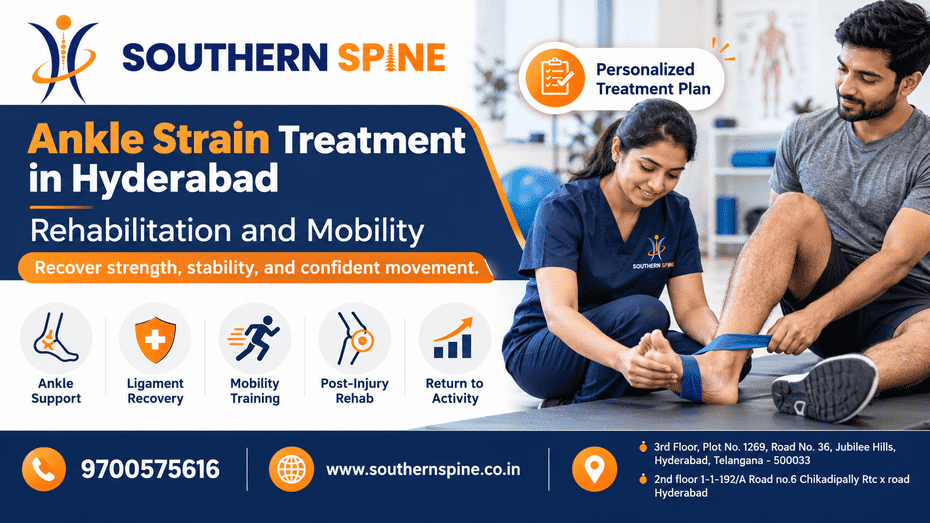
Ankle Strain Treatment in Hyderabad: Rehabilitation and Mobility
Ankle pain, swelling, stiffness, and difficulty walking can affect your daily routine, exercise, and sports activities. An ankle injury may occur after twisting your foot, landing awkwardly, running on uneven ground, or suddenly changing direction during physical activity.
If you are searching for ankle strain treatment in Hyderabad, it is important to identify the type and severity of the injury before beginning rehabilitation. An ankle sprain affects the ligaments that support the joint, while an ankle strain generally involves a muscle or tendon. These injuries can produce similar symptoms but may require different treatment approaches.
Southern Spine provides spine care and rehabilitation-related services in Hyderabad. People experiencing ankle pain or restricted mobility can enquire about an assessment to determine whether rehabilitation is appropriate or whether medical evaluation is needed first.
What Is an Ankle Strain?
An ankle strain occurs when a muscle or tendon around the ankle is overstretched or injured. Tendons connect muscles to bones and help control foot and ankle movement.
An ankle sprain, by comparison, occurs when the ligaments that stabilise the ankle are stretched or torn. Sprains are common after the ankle rolls inward or outward unexpectedly.
Both injuries may cause pain, swelling, and difficulty moving the foot. A clinical assessment can help distinguish these conditions from fractures, tendon injuries, and other causes of ankle pain.
Common Causes of Ankle Strain and Related Injuries
Ankle injuries can occur during sports, exercise, walking, or routine daily activities.
1. Sudden twisting movements
Stepping awkwardly off a curb, walking on uneven ground, or turning quickly can place excessive stress on the ankle’s supporting tissues.
2. Sports and exercise
Running, jumping, football, badminton, basketball, and other activities involving sudden direction changes can increase the risk of ankle injuries.
3. Overuse and repetitive activity
A sudden increase in running distance, exercise intensity, or training frequency may contribute to muscle or tendon irritation around the ankle.
4. Inadequate conditioning
Reduced strength, limited ankle mobility, or poor balance may affect how the ankle responds to sudden movements.
5. Previous ankle injuries
A previous sprain or strain may leave residual weakness or instability if rehabilitation is incomplete. Repeated injuries can make it harder to return confidently to physical activities.
Symptoms of an Ankle Strain
Symptoms depend on the affected tissue and the severity of the injury.
Common signs include:
Pain around the ankle or nearby muscles and tendons.
Swelling or tenderness.
Bruising after an injury.
Stiffness or reduced ankle movement.
Discomfort while walking, standing, or climbing stairs.
Difficulty pushing off the foot during walking.
Reduced balance or a feeling that the ankle may give way.
Severe pain, marked swelling, an obvious deformity, or an inability to bear weight may indicate a more serious injury, including a fracture. Seek prompt medical assessment rather than attempting exercises at home.
Ankle Strain Treatment in Hyderabad: What Are the Options?
Treatment depends on the injured tissue, symptom severity, and whether a fracture or significant ligament or tendon injury is present.
1. Initial assessment
A healthcare professional may ask how the injury occurred and examine swelling, tenderness, ankle movement, walking ability, and stability.
Depending on the findings, an X-ray or other imaging may be recommended to investigate a possible fracture or more serious injury.
2. Protect the ankle and manage swelling
During the early stage, avoid activities that significantly increase pain. Rest from aggravating movements, elevate the foot when possible, and consider applying a cold pack wrapped in a towel for short periods.
A compression bandage or ankle support may be useful in some cases, provided it is fitted correctly and does not restrict circulation.
Do not apply ice directly to the skin. If you have reduced sensation or circulation problems, ask a healthcare professional before using cold therapy.
3. Physiotherapy and rehabilitation
Once the injury has been assessed and movement is safe, physiotherapy may help restore ankle mobility, muscle strength, balance, and walking ability.
A rehabilitation plan may include gentle range-of-motion exercises, progressive strengthening, balance training, and activity-specific exercises.
The exercises should match the injury and healing stage. Beginning high-load exercises too early may aggravate symptoms.
4. Mobility exercises
Ankle mobility may be reduced after swelling, pain, or a period of limited movement. A physiotherapist may recommend gentle movements within a comfortable range.
Depending on the injury, rehabilitation may progress through:
Gentle ankle movements to maintain mobility.
Gradual restoration of comfortable weight-bearing.
Calf and ankle muscle strengthening.
Balance and coordination exercises.
Walking and functional movement training.
Do not force the ankle through sharp pain or continue exercises that increase swelling or instability.
5. Strengthening and stability training
After an ankle injury, restoring strength and balance is important, particularly for people who want to return to sports or regular exercise.
A rehabilitation programme may gradually introduce resistance exercises, controlled heel raises, supported balance activities, and movements related to your daily routine.
The appropriate progression depends on pain, swelling, strength, and stability rather than a fixed timeline.
6. Support devices and medical treatment
Some injuries may require an ankle brace, supportive footwear, crutches, or temporary immobilisation. A healthcare professional can recommend the appropriate option based on the severity of the injury.
Medication for pain may be considered after checking your medical history and other health factors. Seek medical advice before using medication if you have underlying health conditions or take other medicines.
Severe tendon or ligament injuries may require specialist assessment, and surgery is occasionally necessary.
Ankle Rehabilitation Exercises to Improve Mobility
The following exercises are examples of movements that may be used during rehabilitation. They are not suitable for every injury, especially before a fracture or significant tissue injury has been ruled out.
1. Gentle ankle movements
While seated or lying down, slowly move your foot up and down within a comfortable range. This may help maintain mobility when movement is permitted.
2. Ankle circles
Gently move the foot in small circles if doing so does not increase pain. Keep the movement controlled and avoid forcing the ankle.
3. Calf stretching
A calf stretch may be introduced when the injury allows it. A physiotherapist can guide the position and intensity to avoid placing excessive stress on healing tissues.
4. Progressive strengthening
Resistance-band exercises or supported heel raises may be introduced as pain and swelling improve. The timing and resistance should be guided by the type and severity of the injury.
5. Balance training
Supported single-leg balance activities may help improve ankle control once weight-bearing is comfortable and medically appropriate. Begin with support nearby to reduce the risk of falling.
Important: Stop exercising and seek professional advice if pain increases significantly, swelling worsens, or you develop new numbness or instability.
How Long Does an Ankle Injury Take to Recover?
Recovery time varies according to the type of injury, the amount of tissue damage, previous ankle problems, and the demands of your daily activities.
Mild injuries may improve over days to a few weeks, while more serious ligament, muscle, or tendon injuries can take considerably longer. Some injuries require several weeks or months of progressive rehabilitation.
Returning to sport too early may increase the risk of reinjury. Before resuming running, jumping, or sudden direction changes, your ankle should have sufficient movement, strength, balance, and functional control for the activity.
How Can You Prevent Repeated Ankle Injuries?
Although not every ankle injury can be prevented, several measures may help reduce the risk.
Warm up before exercise and sports.
Increase training intensity gradually.
Wear footwear appropriate for the activity.
Strengthen the muscles around the ankle and lower leg.
Include balance and coordination exercises when appropriate.
Take care on uneven surfaces.
Complete rehabilitation after an injury instead of stopping as soon as the pain improves.
Seek assessment if the ankle repeatedly gives way or feels unstable.
People with recurrent ankle injuries may benefit from an individual assessment to identify mobility, strength, balance, or stability problems.
When Should You See a Healthcare Professional?
Arrange an assessment if ankle pain or swelling persists, repeatedly returns, affects normal walking, or is accompanied by instability or tingling.
Seek urgent medical assessment if:
You cannot bear weight or walk a few steps after the injury.
The ankle or foot looks deformed.
You experience severe or rapidly worsening pain or swelling.
You heard a snap or grinding sound during the injury and have significant symptoms.
The foot becomes numb, cold, pale, or unusually discoloured.
These symptoms may indicate a fracture, a significant soft-tissue injury, or another condition requiring prompt treatment.
Ankle Rehabilitation and Mobility Care at Southern Spine, Hyderabad
Southern Spine provides spine-related care and rehabilitation services in Hyderabad. If ankle pain is affecting your mobility, you can contact the clinic to enquire whether an assessment or rehabilitation service is suitable for your needs.
Because ankle injuries can involve muscles, tendons, ligaments, or bones, the correct diagnosis is important before starting treatment. A suspected fracture or serious tendon or ligament injury may require an orthopaedic or other medical evaluation first.
Southern Spine – Jubilee Hills
3rd Floor, Plot No. 1269, Road No. 36, Jubilee Hills, Hyderabad, Telangana – 500033
Southern Spine – Chikkadpally
2nd Floor, 1-1-192/A, Road No. 6, Chikkadpally, RTC X Roads, Hyderabad, Telangana – 500020
Phone: +91 9700575616
Website: https://www.southernspine.co.in/
Contact the clinic to enquire about available services and appointment arrangements.
Conclusion
An ankle strain or related ankle injury can cause pain, swelling, stiffness, and difficulty walking or exercising. Identifying whether the problem involves a muscle, tendon, ligament, or bone helps determine the appropriate treatment.
Depending on the injury, care may include initial protection, swelling management, physiotherapy, mobility exercises, progressive strengthening, and balance training. Returning to sports or demanding physical activities should be gradual and based on recovery of strength, movement, and stability.
If ankle pain is limiting your mobility in Hyderabad, contact Southern Spine to enquire about rehabilitation services. Seek appropriate medical assessment first if the injury is severe or a fracture is suspected.
Frequently Asked Questions
You can contact Southern Spine at +91 9700575616 to enquire about its rehabilitation-related services and whether an assessment is suitable for your condition.
A strain affects a muscle or tendon, while a sprain affects the ligaments that connect and stabilise bones at a joint. Both may cause pain and swelling, so an assessment may be needed to identify the injury.
Physiotherapy may help restore movement, strength, balance, and function after an ankle injury. The exercises and progression depend on the injury's severity and healing stage.
Appropriate footwear, gradual training progression, ankle strengthening, balance exercises, and completing rehabilitation can help reduce the risk of repeat injuries.