
L4-L5 Disc Bulge Treatment in Hyderabad: What Are the Options?
- Home
- Blogs
- L4-L5 Disc Bulge Treatment in Hyderabad: What Are the Options?
Categories
Recent Blogs
L4-L5 Disc Bulge Treatment in Hyderabad: What Are the Options?
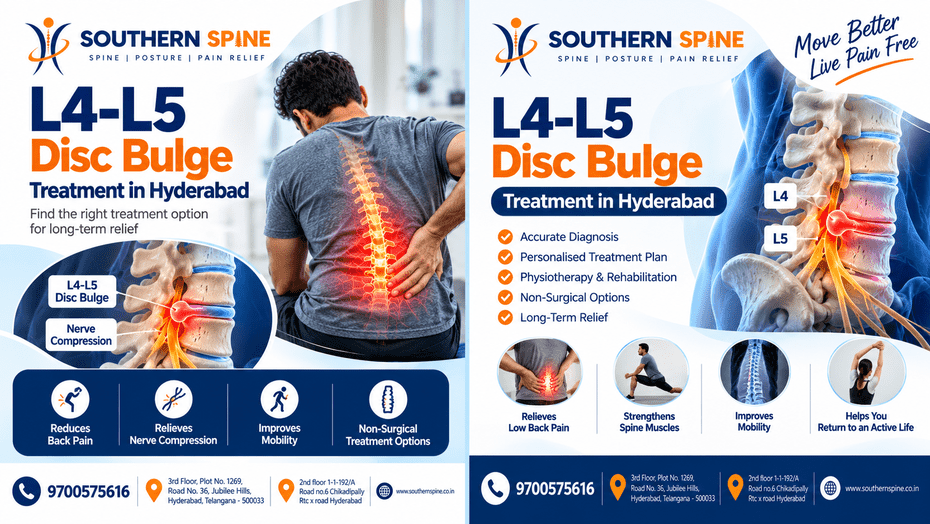
Lower back pain that spreads into the buttocks or legs can sometimes be associated with a disc bulge in the lower spine. One commonly affected area is the L4-L5 level, located between the fourth and fifth lumbar vertebrae. When a disc at this level irritates a nearby nerve, it may cause pain, tingling, numbness, or weakness in the leg.
If you are searching for L4-L5 disc bulge treatment in Hyderabad, understanding the cause of your symptoms is an important first step. Treatment depends on the severity of the disc changes, whether nerves are affected, and how much the symptoms interfere with daily activities.
Southern Spine provides spine care and rehabilitation-related services in Hyderabad. Patients experiencing persistent lower back pain or possible disc-related symptoms can enquire about an assessment to discuss suitable care options.
What Is an L4-L5 Disc Bulge?
The lumbar spine consists of five vertebrae in the lower back. Intervertebral discs sit between these bones and help absorb forces during everyday movements.
An L4-L5 disc bulge occurs when the disc between the fourth and fifth lumbar vertebrae extends beyond its usual boundary. Depending on its location and size, it may or may not affect nearby nerves.
A disc bulge does not automatically mean that a person will experience pain. Some people have disc changes on an MRI without symptoms, while others develop back pain or nerve-related symptoms.
The treatment plan should therefore consider the patient’s symptoms, clinical examination, and imaging findings together.
Common Symptoms of an L4-L5 Disc Bulge
Symptoms vary depending on whether the disc affects nearby nerves and the degree of irritation or compression.
1. Lower back pain
Pain may be felt in the lower back and may worsen during certain movements, prolonged sitting, bending, or lifting.
2. Pain spreading into the leg
If a nerve root is irritated, pain may travel from the lower back into the buttock, thigh, lower leg, or foot. This is sometimes described as sciatica or radicular pain.
3. Tingling or numbness
Some people experience pins and needles or reduced sensation in parts of the leg or foot.
4. Muscle weakness
Nerve involvement may cause weakness in certain leg or foot movements. New or progressive weakness requires prompt medical assessment.
5. Difficulty with everyday activities
Persistent symptoms may make it uncomfortable to sit, stand, walk, bend, sleep, or work for extended periods.
Not every symptom is caused by an L4-L5 disc bulge. Hip conditions, muscle problems, other spinal conditions, and peripheral nerve disorders can produce similar complaints.
What Causes an L4-L5 Disc Bulge?
Several factors may contribute to disc changes or symptoms in the lower back.
Age-related changes: Spinal discs can gradually lose hydration and flexibility with age.
Repetitive physical strain: Repeated lifting, bending, or twisting may aggravate the lower back.
Sudden injury: An unexpected movement or injury may trigger symptoms.
Prolonged sitting: Extended periods in one position may worsen discomfort for some people.
Reduced physical activity: Limited movement and conditioning may affect strength and tolerance for everyday activities.
Individual factors: Genetics, body weight, previous injuries, and other health factors may influence spinal health.
In many cases, there is no single identifiable cause. A healthcare professional can help determine which factors may be relevant to your symptoms.
How Is an L4-L5 Disc Bulge Diagnosed?
A proper assessment helps determine whether the disc finding is related to your symptoms and which treatment options may be appropriate.
Medical history
Your healthcare professional may ask when the pain started, where it travels, what makes it better or worse, and whether you have experienced numbness or weakness.
Physical and neurological examination
An examination may include checking spinal movement, leg strength, sensation, reflexes, walking ability, and symptoms during specific movements.
MRI and other investigations
An MRI can show discs and nearby soft tissues. However, an MRI is not necessary for every episode of lower back pain. A doctor may recommend imaging if symptoms persist, neurological findings are concerning, or the results would influence treatment decisions.
An imaging report should always be interpreted alongside your symptoms and examination findings.
L4-L5 Disc Bulge Treatment in Hyderabad: Available Options
Treatment depends on symptom severity, nerve involvement, general health, and response to initial care. Many people improve with non-surgical treatment, while some require specialist intervention.
1. Physiotherapy and rehabilitation
Physiotherapy may help reduce functional limitations and improve movement, strength, and activity tolerance.
Depending on the assessment, a rehabilitation programme may include:
Gradual exercises for the trunk and supporting muscles.
Gentle mobility exercises.
Strengthening for the hips and lower limbs.
Movement guidance for bending, lifting, and everyday activities.
A gradual return to work, walking, and exercise.
Exercises should be personalised. Avoid movements that significantly worsen pain travelling down the leg or cause new numbness or weakness.
2. Activity modification
Avoiding movements that strongly aggravate symptoms may help during an episode of back pain. However, prolonged bed rest is generally not recommended for uncomplicated lower back pain.
When medically appropriate, gentle walking and gradually resuming normal activities can help maintain mobility.
3. Medication and medical pain management
A doctor may recommend medication to manage pain or other symptoms, taking your medical history and possible side effects into account.
Do not start prescription medicines or combine painkillers without appropriate medical advice.
4. Selected manual therapy
Certain manual techniques may be considered as part of a broader treatment plan for suitable patients. The choice depends on the clinical assessment, the diagnosis, and possible contraindications.
Manual therapy should not replace appropriate neurological assessment. Forceful spinal manipulation may be unsuitable in some conditions, particularly when significant nerve compression or progressive neurological symptoms are suspected.
5. Specialist procedures
If leg pain remains severe despite appropriate treatment, a specialist may consider selected procedures, such as an injection around an irritated nerve, depending on the diagnosis and individual circumstances.
The potential benefits, limitations, and risks should be discussed with the treating specialist.
6. Surgery when necessary
Surgery is not required for every L4-L5 disc bulge. A spine surgeon may consider an operation when symptoms remain severely disabling despite appropriate non-surgical treatment or when significant neurological problems are present.
The decision depends on the clinical findings, imaging, symptom severity, and overall health. Surgery may be urgent in certain cases involving serious nerve compression.
Can an L4-L5 Disc Bulge Be Treated Without Surgery?
Many people with symptomatic disc problems improve without surgery. Non-surgical care may include guided exercise, physiotherapy, activity modification, and medication recommended by a doctor.
However, the appropriate treatment varies from person to person. The presence of an L4-L5 disc bulge on an MRI alone does not determine whether surgery is necessary.
If symptoms are worsening, pain is severely limiting daily activities, or weakness develops, seek medical assessment rather than continuing self-treatment.
Exercises for an L4-L5 Disc Bulge
Exercise selection depends on the individual’s symptoms and examination findings. There is no single exercise routine that is appropriate for every disc bulge.
A physiotherapist may recommend selected movements to improve mobility, build trunk strength, and restore confidence with everyday activities.
Possible elements of a supervised programme include:
Gentle walking, if tolerated.
Comfortable mobility exercises.
Gradual trunk and hip strengthening.
Movement practice for sitting, standing, bending, and lifting.
A progressive return to normal physical activities.
Avoid copying exercise routines online without considering your condition. Stop an exercise and seek professional guidance if it causes significantly increased leg pain, new tingling, numbness, or weakness.
How Long Does Recovery Take?
Recovery depends on the severity of symptoms, whether a nerve is affected, overall health, and the response to treatment.
Some people improve over several days or weeks, while others need a longer period of rehabilitation. Symptoms may fluctuate during recovery, so progress is often assessed by changes in pain, walking ability, strength, and everyday function.
Follow-up assessment may be useful if improvement is limited or symptoms continue to return.
When Should You Seek Urgent Medical Care?
Arrange a medical assessment if lower back pain persists, spreads into the leg, or is accompanied by ongoing tingling or numbness.
Seek emergency medical care immediately if you develop:
New difficulty controlling your bladder or bowel.
Difficulty passing urine.
Numbness around the groin or saddle area.
Rapidly worsening weakness in one or both legs.
Severe neurological symptoms that develop suddenly.
These symptoms may indicate serious nerve compression and should not be managed with home exercises or routine manual therapy.
L4-L5 Disc Bulge Care at Southern Spine, Hyderabad
Southern Spine provides spine-related care in Hyderabad, including chiropractic care, back pain treatment, sciatica-related care, and corrective exercises.
If you are experiencing lower back pain or symptoms that may be associated with an L4-L5 disc bulge, you can contact the clinic to enquire about an assessment and discuss suitable care options.
Southern Spine – Jubilee Hills
3rd Floor, Plot No. 1269, Road No. 36, Jubilee Hills, Hyderabad, Telangana – 500033
Southern Spine – Chikkadpally
2nd Floor, 1-1-192/A, Road No. 6, Chikkadpally, RTC X Roads, Hyderabad, Telangana – 500020
Phone: +91 9700575616
Website: https://www.southernspine.co.in/
Treatment recommendations depend on your symptoms and clinical findings. If significant weakness or other serious neurological signs are present, medical or specialist evaluation should take priority.
Conclusion
An L4-L5 disc bulge can be associated with lower back pain, leg pain, tingling, numbness, or weakness, although some people have no symptoms at all. The right treatment depends on whether the disc is actually responsible for the symptoms and whether nearby nerves are affected.
Treatment options in Hyderabad may include physiotherapy, guided exercises, activity modification, medical pain management, and specialist procedures when appropriate. Surgery may be considered in selected cases, particularly when symptoms remain disabling or neurological problems develop.
If persistent lower back pain is affecting your daily routine, contact Southern Spine in Hyderabad to enquire about an assessment and discuss appropriate care options.
Frequently Asked Questions
You can contact Southern Spine at +91 9700575616 to enquire about its spine care and rehabilitation-related services at its Jubilee Hills and Chikkadpally locations.
Symptoms may include lower back pain, pain spreading into the buttock or leg, tingling, numbness, or muscle weakness. Some people have an L4-L5 disc bulge without experiencing any symptoms.
Many people improve without surgery. Treatment may include guided exercises, physiotherapy, activity modification, and medication prescribed by a doctor. Some cases require specialist intervention.