Slip Disc Treatment in Jubilee Hills Check Post, Hyderabad
- Home
- Blogs
- Slip Disc Treatment in Jubilee Hills Check Post, Hyderabad
Categories
Recent Blogs
Slip Disc Treatment in Jubilee Hills Check Post, Hyderabad
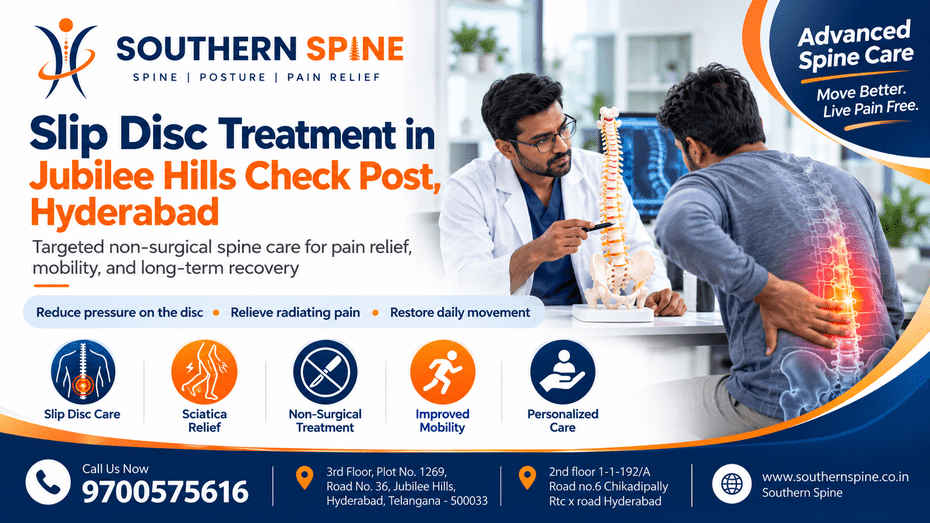
A slip disc can cause lower back pain, neck pain, muscle stiffness, tingling, numbness, or pain that travels down the arms or legs. These symptoms can affect daily activities such as walking, sitting, bending, sleeping, and working. Finding the right treatment early can help you manage symptoms and improve mobility.
If you are searching for slip disc treatment in Jubilee Hills Check Post, Hyderabad, Southern Spine provides spine care and rehabilitation services tailored to individual needs. The treatment approach depends on the location of the affected disc, the severity of symptoms, and the findings of a clinical assessment.
At Southern Spine, patients can consult Dr. Raghupathi Jadhav for an assessment of spine-related concerns and guidance on appropriate conservative care where suitable.
What Is a Slip Disc?
A slip disc, medically known as a herniated or prolapsed disc, occurs when the soft inner material of an intervertebral disc pushes through a weakened or damaged outer layer. These discs act as cushions between the bones of the spine.
A herniated disc may irritate or compress nearby nerves, causing pain and other symptoms. It can develop in the lower back, known as the lumbar spine, or in the neck, known as the cervical spine.
Not every disc bulge causes pain. Treatment depends on the patient’s symptoms, physical examination, and medical history rather than an imaging finding alone.
Common Symptoms of a Slip Disc
The symptoms of a slip disc vary depending on the affected disc and whether a nerve is involved.
Common symptoms include:
Lower back pain that worsens with certain movements.
Neck pain or stiffness.
Pain radiating from the lower back into the buttock or leg.
Tingling or numbness in the arms, hands, legs, or feet.
Muscle weakness in an affected limb.
Difficulty sitting, bending, lifting, or walking comfortably.
If symptoms persist, worsen, or interfere with daily activities, consult a qualified healthcare professional for an appropriate evaluation.
What Causes a Slip Disc?
A slip disc may develop due to several factors, including:
Age-related disc changes
As people age, spinal discs can lose some of their water content and flexibility, making them more vulnerable to damage.
Incorrect lifting techniques
Repeatedly lifting heavy objects, especially while twisting or bending, can increase stress on the spine.
Prolonged sitting
Long periods of sitting without movement breaks may contribute to back discomfort, particularly when combined with poor workstation ergonomics and reduced physical activity.
Sudden injury or excessive strain
An accident, sudden twisting movement, or strenuous activity may contribute to disc injury.
Reduced muscle strength
Limited strength and endurance in the muscles supporting the trunk may make everyday physical activities more difficult to tolerate.
Understanding the factors contributing to your symptoms can help guide a suitable treatment and rehabilitation plan.
Slip Disc Treatment Near Jubilee Hills Check Post
Treatment for a slip disc depends on the severity of the condition. Many people improve with non-surgical management, while some require specialist medical intervention.
1. Clinical assessment
A healthcare professional may review your symptoms, medical history, movement limitations, and neurological function. Depending on the findings, imaging such as an MRI may be recommended by your treating doctor.
An MRI is not necessary for every case of back pain, and its results should be interpreted alongside your symptoms and examination.
2. Physiotherapy and rehabilitation
A structured physiotherapy programme may help improve movement, strength, flexibility, and tolerance for daily activities.
Exercises should be selected according to your symptoms and functional limitations. Movements that significantly increase radiating pain, numbness, or weakness should not be continued without professional guidance.
3. Pain management
A doctor may recommend appropriate pain-relief measures or medication after considering your medical history and other health factors.
Persistent or severe pain may require further assessment by a spine specialist or pain-management specialist.
4. Activity modification
Complete bed rest is generally not recommended for uncomplicated back pain. Gentle movement and a gradual return to normal activities may be beneficial when medically appropriate.
Your healthcare professional can advise you on temporary activity modifications and how to resume work, exercise, and daily routines safely.
5. Surgery when necessary
Surgery is not required for every slip disc. However, a specialist may consider it when there is significant or progressive neurological weakness, certain nerve-compression symptoms, or persistent disabling pain despite appropriate non-surgical treatment.
The decision should be based on a specialist’s assessment of the symptoms, examination findings, imaging, and overall health.
Can a Slip Disc Be Treated Without Surgery?
Many people with a herniated disc improve without surgery. Depending on the individual condition, treatment may include guided exercises, physiotherapy, appropriate medication, activity modification, and follow-up care.
However, non-surgical treatment is not suitable for every patient. Severe nerve compression or worsening neurological symptoms may require urgent specialist attention.
Avoid relying on online exercises or unverified treatments as a substitute for a clinical assessment.
Can Chiropractic Care Help With Slip Disc Symptoms?
Chiropractic care may involve movement assessment, selected manual techniques, and exercise guidance for certain musculoskeletal conditions. Whether it is appropriate for a person with a herniated disc depends on the diagnosis, symptoms, and neurological findings.
Spinal manipulation is not suitable for every slip disc, particularly when there are signs of significant nerve compression or other serious spinal conditions. High-velocity manipulation should not be performed without appropriate assessment and consideration of contraindications.
A qualified healthcare professional can help determine whether physiotherapy, gentle manual techniques, exercise-based rehabilitation, medical treatment, or referral to a spine specialist is the safest option.
When Should You See a Spine Specialist?
You should arrange a medical assessment if you experience:
Back or neck pain that continues or repeatedly returns.
Pain spreading into an arm or leg.
Persistent tingling or numbness.
Difficulty walking or performing daily activities.
Symptoms that are getting worse despite initial care.
Seek emergency medical care immediately if you develop new difficulty controlling your bladder or bowel, difficulty passing urine, numbness around the groin or saddle area, or rapidly worsening leg weakness. These may indicate serious nerve compression that requires urgent assessment.
How to Prevent Further Back Strain
Although not all disc problems can be prevented, healthy movement habits may help reduce unnecessary strain on the spine.
Take regular movement breaks during prolonged sitting.
Adjust your chair, desk, and screen to support a comfortable posture.
Use appropriate lifting techniques and avoid twisting while carrying heavy objects.
Build core and back strength through exercises suited to your condition.
Increase physical activity gradually rather than suddenly overloading your body.
Follow your rehabilitation plan consistently.
Maintain a comfortable sleeping position and use a supportive mattress that suits your needs.
If an activity increases your symptoms, seek professional advice before continuing or increasing its intensity.
Why Consider Southern Spine for Slip Disc Treatment in Jubilee Hills?
Southern Spine provides chiropractic care and spine-related rehabilitation services in Hyderabad. Its approach includes assessment, personalised treatment planning, corrective exercises, and follow-up support according to individual needs.
Patients looking for slip disc treatment near Jubilee Hills Check Post can contact the clinic to discuss their symptoms and arrange an assessment.
The clinic’s Jubilee Hills location is:
Southern Spine
3rd Floor, Plot No. 1269, Road No. 36, Jubilee Hills, Hyderabad, Telangana – 500033
Phone: +91 9700575616
Website: https://www.southernspine.co.in/
Treatment recommendations should be based on an individual clinical assessment. If your symptoms suggest serious nerve compression, seek medical or specialist evaluation rather than relying solely on conservative care.
Conclusion
If you are searching for slip disc treatment in Jubilee Hills or near Jubilee Hills Check Post, understanding the cause of your symptoms is an important first step. A suitable treatment plan may include physiotherapy, guided exercises, activity modification, pain management, or specialist care depending on the severity of the condition.
Southern Spine offers spine care and rehabilitation services in Jubilee Hills, Hyderabad. Contact the clinic to discuss your symptoms and determine whether an assessment is appropriate for your needs.
Frequently Asked Questions
Southern Spine is located at 3rd Floor, Plot No. 1269, Road No. 36, Jubilee Hills, Hyderabad. You can contact the clinic at +91 9700575616 to enquire about an assessment.
Common symptoms include back or neck pain, pain radiating into an arm or leg, tingling, numbness, and sometimes muscle weakness. Some disc abnormalities cause no symptoms.
Recovery varies depending on the severity of the disc problem, nerve involvement, general health, and response to treatment. Some people improve over several weeks, while others require longer rehabilitation or specialist care.
Many people improve with non-surgical treatment, including physiotherapy, guided exercises, activity modification, and appropriate medical care. Surgery may be necessary in selected cases, especially when significant nerve compression or progressive weakness is present.